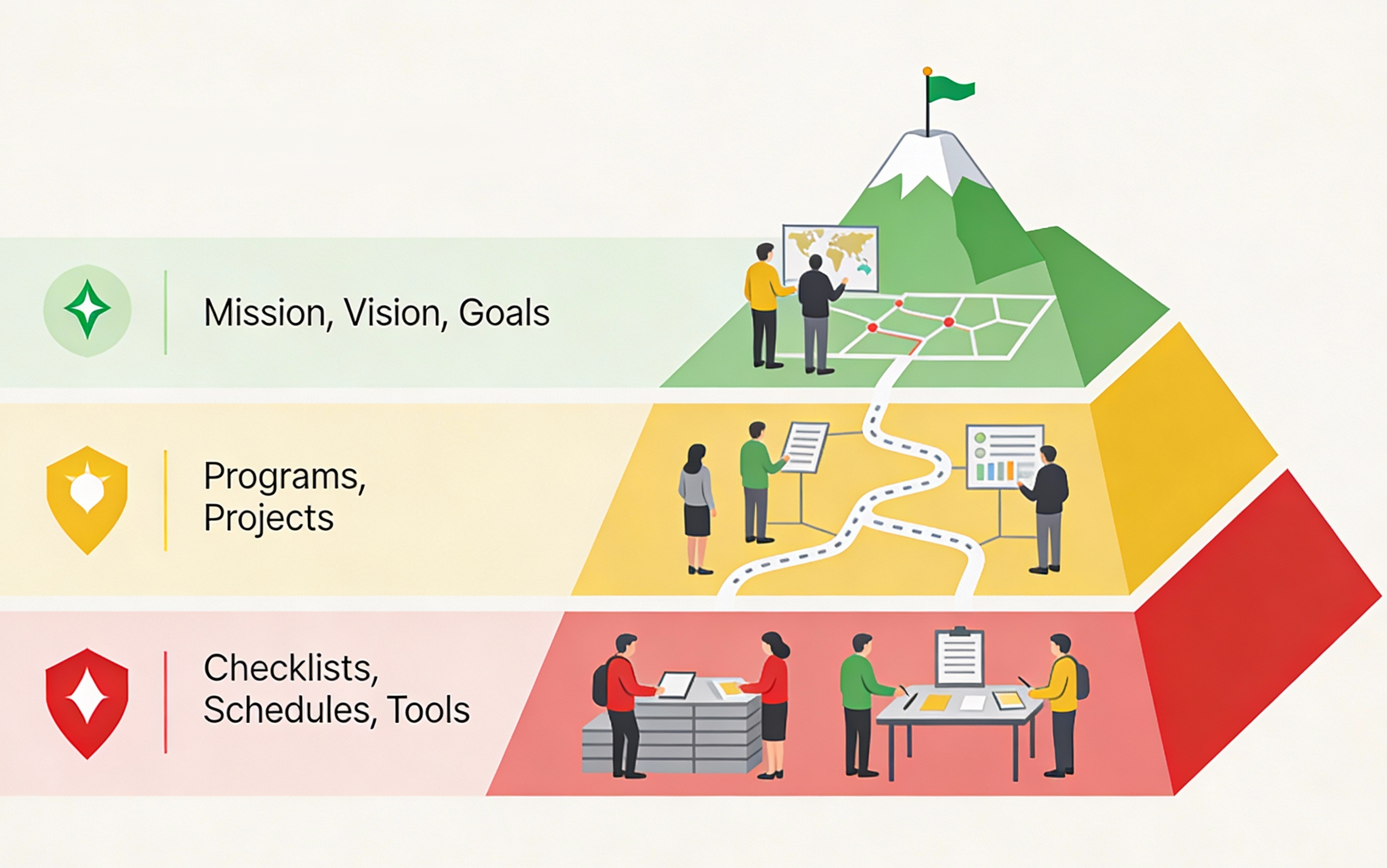
Levels of Organizational Planning
Effective planning in any organization operates across three distinct levels: strategic (🟢), tactical (🟡), and operational (🔴). Each serves a unique purpose, ensuring alignment from high-level vision to daily execution.
🟢 Strategic Planning
This involves defining the organization's mission, values, priorities, and growth directions. The outcome is a strategic plan document that outlines the mission (the problem being solved), vision (the world post-solution), goals (required changes), and tasks (tools to achieve them).(see the generated image above)
It provides direction, much like spotting a distant mountain peak during a hike—you know your endpoint even if paths detour around lakes or rivers. Without it, efforts risk stagnation.
When it's needed: For growth-oriented initiatives aiming to solve real problems. Skip it only in early exploratory stages when team competencies and resources are undefined.
🟡 Tactical Planning
This bridges abstract strategy and routine work, focusing on programs, projects, staff management, donor relations, and funding strategies to realize goals.
It's essential when pursuing a long-term mission but skippable for short-term (under a year) projects, like a one-day hike on a marked trail where improvisation suffices.
When it's needed: Alongside a clear strategic vision to turn ambitions into actionable paths.
🔴 Operational Planning
This covers daily routines: who does what, how, and why. Even small tasks must be intentional to avoid derailing larger efforts—neglect them, and projects fail.
Always required: No initiative survives without it, from neighborhood chats to major expeditions.
True success demands all three levels. Claims that "planning is impossible here" often confuse them—clarify, and the path forward becomes clear.